
Is It Time to Downsize Your Orlando Home? 7 Signs You're Ready
⚡ Quick Summary
- The Core Answer: Tactical architectural alignment (right-sizing) allows Orlando homeowners to unlock trapped equity and shed property administrative drag by shifting closer to primary employment infrastructures across Horizon West, Dr. Phillips, Baldwin Park, or Winter Park to permanently eliminate peak I-4 and SR-417 commute gridlock.
- The Financials: Shifting to an efficient townhome format drops monthly expenditures to an all-in average of $3,400–$3,500 compared to single-family carrying costs exceeding $4,100, though buyers must map hidden monthly association line items which average $300 across the market and approach a $490 benchmark for multi-family condominiums.
- The Risk: Downsizing transitions frequently stall due to sellers anchoring to obsolete pandemic-era valuation peaks, underestimating transaction-level HOA transfer and estoppel fees, or miscalculating Florida Homestead Portability limits required by the Orange County Property Appraiser to preserve *Save Our Homes* tax differentials.
Downsizing isn't a retirement checklist item. It's a financial and lifestyle decision — one that Orlando homeowners in their 40s, 50s, and 60s are making for reasons that have nothing to do with age and everything to do with alignment. When the home no longer fits the life, the math usually follows. If you are beginning to evaluate whether you should downsize your Dr. Phillips home, this transition is actually more about downsizing vs. right-sizing to better suit a changing daily routine.
This guide walks through the signals that matter, what downsizing actually costs in the Orlando market, which neighborhoods tend to work best, and what can go wrong — so you can make a deliberate decision rather than a forced one.

How Do You Know When It's Time to Downsize in Orlando?
The clearest signal is a persistent mismatch between what your home demands and what your life actually needs. If you find yourself repeatedly questioning is it time to downsize, four friction points tend to push Orlando homeowners toward this decision: housing costs consuming more than roughly 28–30% of gross income, rooms sitting unused for months, maintenance eating 8–10+ hours per week, and commute times on I-4 or SR-417 that no longer justify the distance from work. When two or more of these overlap, the financial case for downsizing is usually worth modeling, especially when you consider the overall cost of staying in a large Orlando home.
What makes Orlando different from national patterns is the combination of Florida's insurance environment, HOA-heavy housing stock, and a job market anchored by employers like Walt Disney World, AdventHealth, UCF, and Lockheed Martin. These local realities change the downsizing calculus in ways that generic guides rarely address.
Common Triggers Worth Taking Seriously
- Unused square footage: A 4-bedroom home occupied by one or two people means you're paying taxes, insurance, and utilities on space that generates no value.
- Rising carrying costs: Florida property insurance premiums, HOA increases, and property taxes that have been climbing since reassessment cycles can tip a comfortable payment into a strained one.
- Maintenance burden: Pools, large yards, and two-story layouts require time and money that often feel disproportionate as households shrink. Transitioning from lakefront to smaller lot maintenance can save thousands annually.
- Commute friction: I-4 morning inbound (7–9:30 AM) and evening outbound (4–6:30 PM) can add 15–30 minutes each way compared to off-peak. A smaller home 10–15 miles closer to work can reclaim meaningful hours weekly.
- Equity lock-in: Many Orlando homeowners who purchased between 2015 and 2021 are sitting on significant equity that, when unlocked, could eliminate a mortgage payment or fund a decade of retirement.
Curious how your current equity translates to a right-sized property?
Don't guess on your tax portability or carrying costs. Get a precise, mathematical breakdown of your portfolio's liquidity.
Request a Confidential Equity AuditWhat Does Downsizing Actually Cost in the Orlando Market?
Downsizing reduces some costs and shifts others — it rarely eliminates them. The net monthly savings depend heavily on which housing type you move into and which neighborhood you choose. A townhome in a well-managed community will typically run $3,400–$3,500 per month all-in (mortgage, taxes at roughly 1.1%, insurance, HOA, utilities, and a 1% maintenance reserve), compared to $4,100 or more monthly for a larger single-family home carrying a higher maintenance burden and no HOA. The difference is real, but so are the variables.
HOA fees are the most commonly underestimated line item. City-wide averages in Orlando run around $300 per month across all property types, with condos averaging closer to $490. For part-time residents, aligning these monthly carry items with specific HOA rules for seasonal residents in Orlando is vital to prevent compliance or property management penalties during the off-season. This is why conducting CDD and HOA financial audits is a critical step in our strategy to protect your investment.
Hidden Costs That Catch Downsizers Off Guard
- HOA transfer and estoppel fees: Many Orlando associations charge hundreds of dollars at closing — often overlooked in early transaction budgeting.
- Special assessments: Aging condo buildings may have upcoming capital projects. According to the Florida Condominium Act, buyers should be diligent in reviewing structural integrity reserve studies.
- Homestead recalculation: When you sell and buy in the same county, Florida Homestead Portability allows you to transfer some of your existing Save Our Homes cap benefit. Consult the Orange County Property Appraiser to verify your specific portability amount.
- Insurance transition: Moving to a newer structure can reduce premiums. Check current FEMA Flood Maps to see if your target neighborhood requires additional coverage.
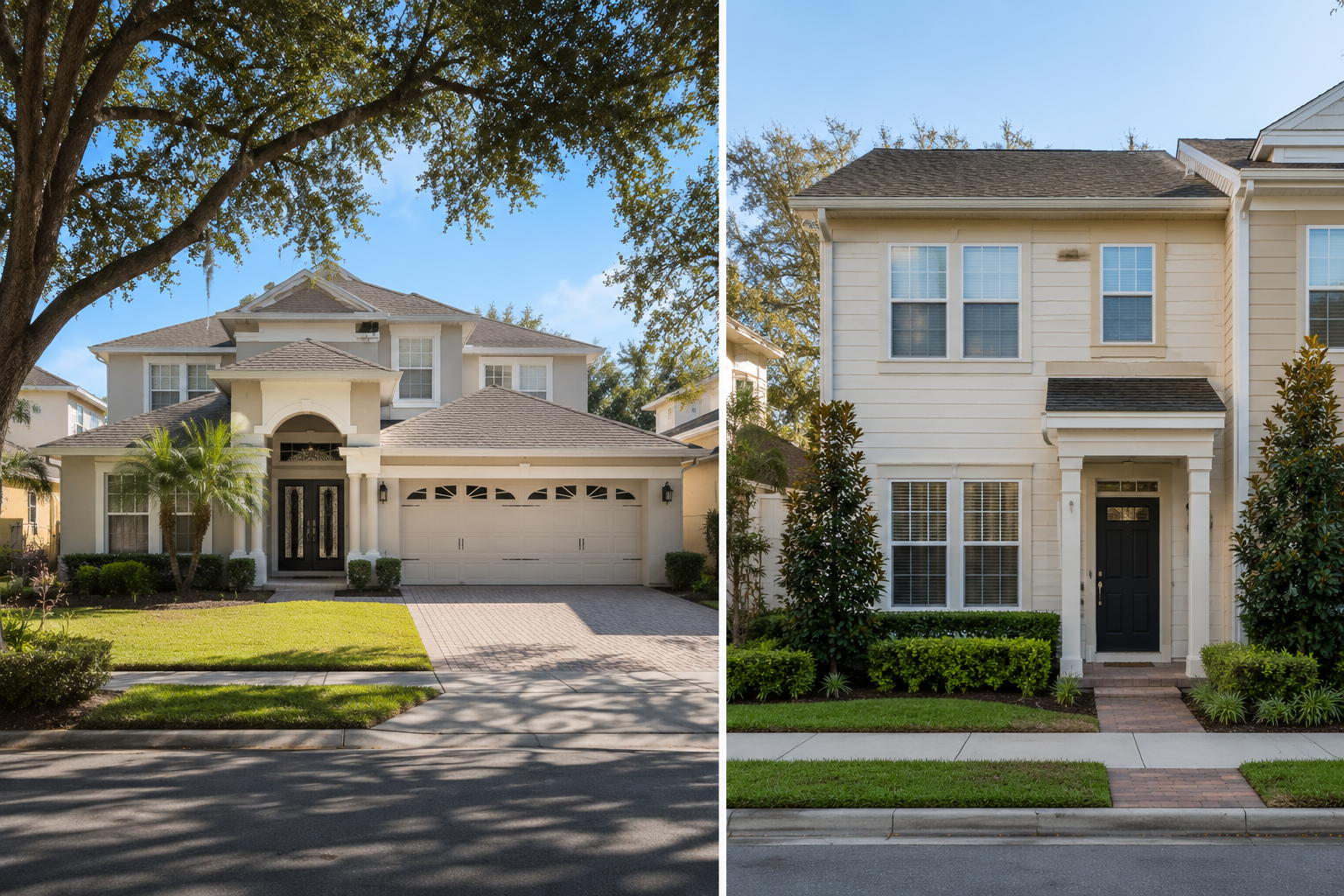
Which Housing Type Makes the Most Sense When Downsizing in Orlando?
For most Orlando downsizers, townhomes offer the best balance. For those moving within specific luxury enclaves, exploring luxury villas and townhomes in Dr. Phillips provides a maintenance-free lifestyle without sacrificing high-end finishes. The right answer depends on your maintenance tolerance, health trajectory, and how long you plan to stay.
Housing Type Comparison for Orlando Downsizers
Non-HOA Single-Family
Typical HOA: None
Maintenance Burden: High (owner-managed)
Best For: Privacy-first, flexible households
Townhome or Villa
Typical HOA: $200–$350/mo
Maintenance Burden: Low-Moderate
Best For: Lock-and-leave working downsizers
55+ Community
Typical HOA: Varies widely
Maintenance Burden: Low
Best For: Empty nester communities in Dr. Phillips
Which Orlando Neighborhoods Work Best for Downsizing?
Location is where the downsizing decision gets Orlando-specific. When narrowing down options across the top 5 Orlando luxury communities, your choice will dictate your quality of life for the next decade, whether you are prioritizing medical vs. entertainment proximity or seeking walkable Orlando neighborhoods.
By Lifestyle and Employer Proximity
- The Butler Chain / Lakefront Downsizer: Many high-net-worth owners want to shed the 6,000 sq. ft. operational drag but refuse to give up water access. Moving from a sprawling estate to a premium waterfront condo or smaller footprint villa in Windermere preserves your Butler Chain proximity and resale value without the weekend yard work.
- Disney / Universal Corridor: Downsizers land in Horizon West or Dr. Phillips. Many prioritize Sand Lake Road access vs. quiet residential pockets to keep commutes manageable. For those looking for the ultimate convenience, check our guide on walkable neighborhoods in Dr. Phillips.
- AdventHealth / Orlando Health: Baldwin Park and Winter Park remain the gold standard for healthcare professionals seeking proximity to the urban core.

What Are the Most Common Reasons Downsizing Deals Fall Apart?
Knowing these five failure points gives you time to solve them before they become crises. If you are struggling with the first step, we have a guide on why your Orlando home might not be selling in the current market. To properly calibrate your coordinate transaction, it is also essential to map out localized sales metrics like how long it takes to sell a luxury home in Orlando.
1. Pricing to 2022–2023 peak comps. Sellers who anchor to pandemic-era prices tend to sit longer.
2. No clear next home. Understanding how to sell and buy simultaneously is vital to a smooth transition.
3. Condo HOA problems. High delinquency or lack of reserves can kill financing.
4. Roof age and insurance. Address this proactively to avoid factors that hurt resale value in Dr. Phillips.
5. Tax miscalculations. Always consult the official property appraiser regarding your portability status.
Frequently Asked Questions About Downsizing in Orlando
Will downsizing in Orlando actually lower my monthly expenses?
For most, yes. But you must model the total cost of taxes and HOAs in Orlando to ensure the "smaller" home isn't more expensive monthly.
How does Florida's homestead exemption work when I downsize?
You can often port your Save Our Homes benefit. This is a primary focus for maintaining property value during a move.
Can I keep my current home as a rental?
It is possible, but becoming a landlord in Florida adds complexity. Many prefer to sell and use the equity to buy a lock-and-leave property, leveraging a dedicated Dr. Phillips snowbird home buyer guide to secure the perfect seasonal retreat.
If you're ready to start the process, feel free to contact our team for a custom downsizing analysis.

Yousef Zeidan
Luxury Right-Sizing, Downsizing, and Tax-Sensitive Relocation Specialist
Specializing in luxury right-sizing, downsizing, and tax-sensitive relocation in Dr. Phillips, Windermere, and the Butler Chain of Lakes.
- Brokerage: RE/Max Prime Properties
- License ID: SL3520428
- Phone: +1 (917) 743-8865
- Email: yousef@floridalistings.io
- Office Address: 2713 St Armand Ct, Orlando, FL 32835, USA
Categories
Recent Posts







Request Your Confidential Risk Audit