Moving From New York to Doctor Phillips: The 2026 Domicile & Tax Transition Guide
⚡ Quick Summary
- The Core Rule: Shielding wealth from New York's 14.776% combined state and city tax ceiling requires establishing a legally bulletproof Florida domicile that satisfies the New York Tax Appeals Tribunal's strict Matter of Hoff (DTA No. 850209) standard by genuinely transferring your "near and dear" life to Central Florida rather than just executing a superficial checklist.
- The Logistics: To combat the NY Department of Taxation & Finance's aggressive 10-month rule regarding permanent places of abode (PPA), relocators must build a precise, geolocated physical day record within their first 90 days while transitioning critical business and family ties to Doctor Phillips (32819), Windermere (34786), or Lake Nona (32827).
- The Financials: Strategic purchasing avoids severe carrying-cost drag; established Doctor Phillips subdivisions like Vizcaya carry $0 in Community Development District (CDD) bond assessments, whereas ultra-luxury enclaves like Isleworth layer six-figure country club initiation fees on top of high-value property insurance lines.
If you earn a significant income in New York and you're considering a permanent move to Central Florida, the stakes are higher than most people realize.
The decision isn't just about finding the right home on the Butler Chain of Lakes or getting your children into a top-rated Orange County school. It's about constructing a legally defensible new life — one that will hold up under the relentless scrutiny of a New York State residency audit that can arrive years after you've moved.
In my experience advising families relocating from Manhattan, Westchester, and Long Island to premium communities like Doctor Phillips and Windermere, the single most expensive mistake is treating the move as a simple real estate transaction first and a legal tax transition second. This guide reverses that order entirely.
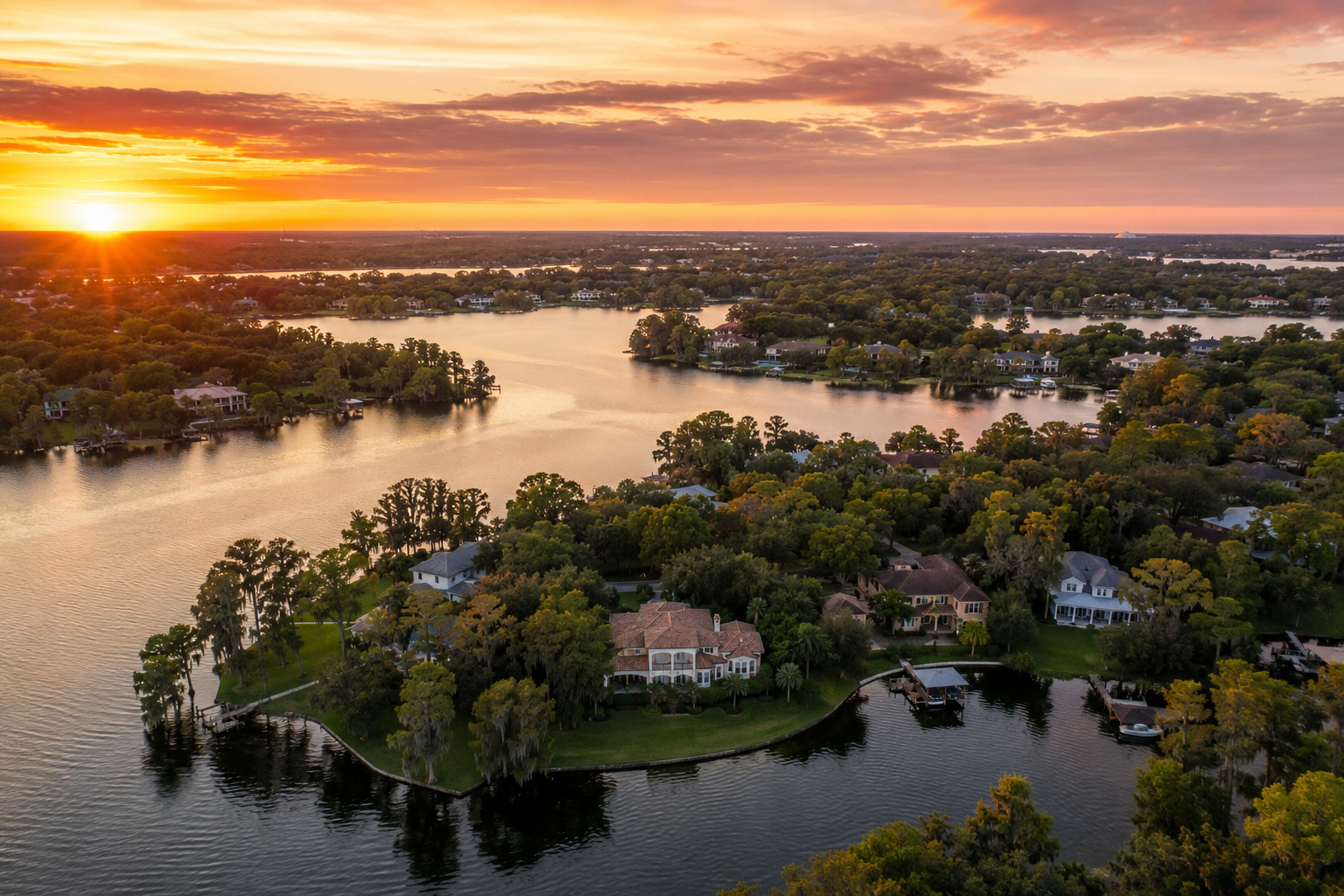
What Is the Real Property and Income Tax Difference Between NY and FL?
For a high-income earner in Manhattan, the combined state and city income tax burden reaches as high as 14.776% — on top of federal brackets. Florida collects zero state income tax, zero estate tax, and zero inheritance tax. For a household with $1 million in annual taxable income, the annual savings after a successful domicile change can exceed $140,000, compounding dramatically over a decade of wealth preservation.
- New York State income tax: Up to 10.90% on top tax brackets.
- New York City resident tax: An additional localized layer scaling up to 3.876%.
- New York estate tax: Up to 16%, with a dangerous "cliff" provision that taxes the entire estate — not just the amount over the threshold — if you exceed the exemption by more than 5%.
- Florida equivalent for all three structural lines: $0.
The estate tax cliff provision alone is an absolute planning emergency for families with legacy estates approaching New York exemption thresholds. Review our complete Orlando property tax framework analysis to see how real estate variables offset these margins.
Why Is a New York Domicile Audit So Dangerous?
The Substance vs. Paperwork Precedent: Matter of Hoff
New York State auditors operate under a strict legal presumption that your historic domicile continues indefinitely until you prove otherwise by clear and convincing evidence. A Tax Appeals Tribunal ruling — Matter of Hoff (DTA No. 850209) — established that filing a Florida Declaration of Domicile, getting a Florida driver's license, and joining a local country club are insufficient on their own. In Hoff, taxpayers lost their appeal because their primary New York home remained fully active, business income was still derived from New York operations, and "near and dear" items (heirlooms, primary medical ties) were never genuinely moved.
The lesson for anyone buying in Windermere or Doctor Phillips is direct: your Florida home must become the undeniable center of your primary life, not a well-decorated secondary property.
The DTF Audit Guideline Change: The 10-Month Rule
The New York State Department of Taxation and Finance enforces Nonresident Audit Guidelines regarding the definition of "substantially all of the taxable year" — the benchmark used to determine whether you maintain a permanent place of abode (PPA) in New York — shortening the window from more than 11 months to more than 10 months.
This means individuals who retain a New York property and spend even modest time there face a significantly lower bar for being reclassified as a full New York resident for tax purposes. Retaining a Manhattan co-op or Hamptons home while buying in Doctor Phillips requires proactive estate structuring (such as irrevocable trusts or arm's-length leasing) with tax counsel prior to closing.
Doctor Phillips vs. Windermere vs. Lake Nona: Submarket Profiles
Doctor Phillips (32819)
CDD Debt: $0 (Vast majority of subdivisions)
Profile: Established 1980s–2000s gated enclaves, Restaurant Row dining, and a proven public school pipeline (Dr. Phillips High).
Windermere (34786)
CDD Debt: $0 in established enclaves
Profile: Ultra-luxury custom estates (Isleworth, Keene's Pointe), deep-water Butler Chain frontage, and maximum privacy.
Lake Nona (32827)
CDD Debt: $1,500–$4,000+/yr on tax bill
Profile: Modern master-planned technology and healthcare hub, Medical City anchors, and a 10-minute drive to MCO Airport.

How Florida Homestead Protects Your Asset Base
Filing for the Florida Homestead Exemption before the March 1st statutory deadline reduces the assessed value of a qualifying primary residence by up to $50,000 for property tax calculations.
More importantly, the Save Our Homes cap restricts annual assessment growth to 3% or CPI (whichever is lower). For domicile audit defense, receiving the Homestead Exemption serves as objective third-party evidence that Florida is your primary legal residence. Review application guidelines in our Florida Homestead Portability Guide.
The First 90 Days Post-Closing: Building Your Domicile Record
The first 90 days post-closing are critical for building an audit-defensible factual record based on the primary criteria used by state auditors:
Family Infrastructure & Amenities in Doctor Phillips
The Doctor Phillips lifestyle is supported by institutional anchors like Dr. P. Phillips Community Park (splash pads, dog parks, pavilions) and the Dr. P. Phillips YMCA Family Center (ISR infant swimming, youth sports leagues, wellness suites).
For families accustomed to dense northern urban centers, having walkable park access and organized sports within a single neighborhood radius represents a significant quality-of-life upgrade. See our guide to walkable Orlando neighborhoods.
Homeowners Insurance Realities
For buyers moving from a condo or co-op structure where master policies handled building coverage, transitioning to single-family underwriting in Florida requires a thorough pre-closing audit. Premium variations depend heavily on roof age and wind mitigation credits, which we detail in our luxury home cost comparison index.
Planning a Luxury NY to Florida Relocation?
Do not leave your wealth preservation strategy to a generic real estate layout. Partner with an advisory panel that coordinates directly with your tax and legal counsel to map out a frictionless, audit-insulated transition blueprint.
Direct Strategy Line: (917) 743-8865
Frequently Asked Questions
What is the New York DTF 10-month rule for residency audits?
The New York State Department of Taxation and Finance revised its Nonresident Audit Guidelines regarding statutory residency, defining 'substantially all of the taxable year' for maintaining a permanent place of abode (PPA) as a period exceeding 10 months (lowered from 11 months). Retaining access to a New York residence for more than 10 months significantly increases audit exposure if you spend more than 183 days in the state.
Do homes in Doctor Phillips, Orlando carry CDD bond assessments?
The vast majority of established subdivisions in Doctor Phillips (32819) carry $0 in Community Development District (CDD) assessments, as they were built before municipal bond financing became prevalent in Central Florida. This offers a clear $1,500–$4,000+ annual carrying-cost advantage over newer master-planned corridors like Lake Nona or Horizon West.
What is the difference between Isleworth and Keene's Pointe in Windermere?
Isleworth is an ultra-luxury, low-density enclave of custom estates anchored by an Arnold Palmer Championship course with six-figure initiation fees. Keene's Pointe is a larger, highly liquid gated family community featuring a Jack Nicklaus Signature layout with a different social and fee structure.
Yousef Zeidan
Luxury Right-Sizing, Downsizing, and Tax-Sensitive Relocation Specialist
Specializing in luxury right-sizing, downsizing, and tax-sensitive relocation in Dr. Phillips, Windermere, and the Butler Chain of Lakes.
- Brokerage: RE/MAX Prime Properties
- License ID: SL3520428
- Phone: +1 (917) 743-8865
- Email: yousef@floridalistings.io
- Office Address: 2713 St Armand Ct, Orlando, FL 32835, USA
Categories
Recent Posts







Request Your Confidential Risk Audit